
BOFFINS. Ah, good old boffins. Where would tabloid journalists be without them? They’re up there with ‘blaze’ and ‘fury’ among those words that nobody uses in conversation, but which crop up in so many news headlines.
Like the one above.
I make no apology. My career has been rooted in tabloid newspapers – there’s been a couple of broadsheets along the way, too – and, besides, haven’t NASA boffins just been examining dust dramatically snatched from an asteroid?
Which brings me belatedly to the point. NASA boffins were amazed by something found much closer to home – an uncannily accurate moon globe dating back all the way to the late 1790s, when King George III was on the English throne.
 Artist John Russell
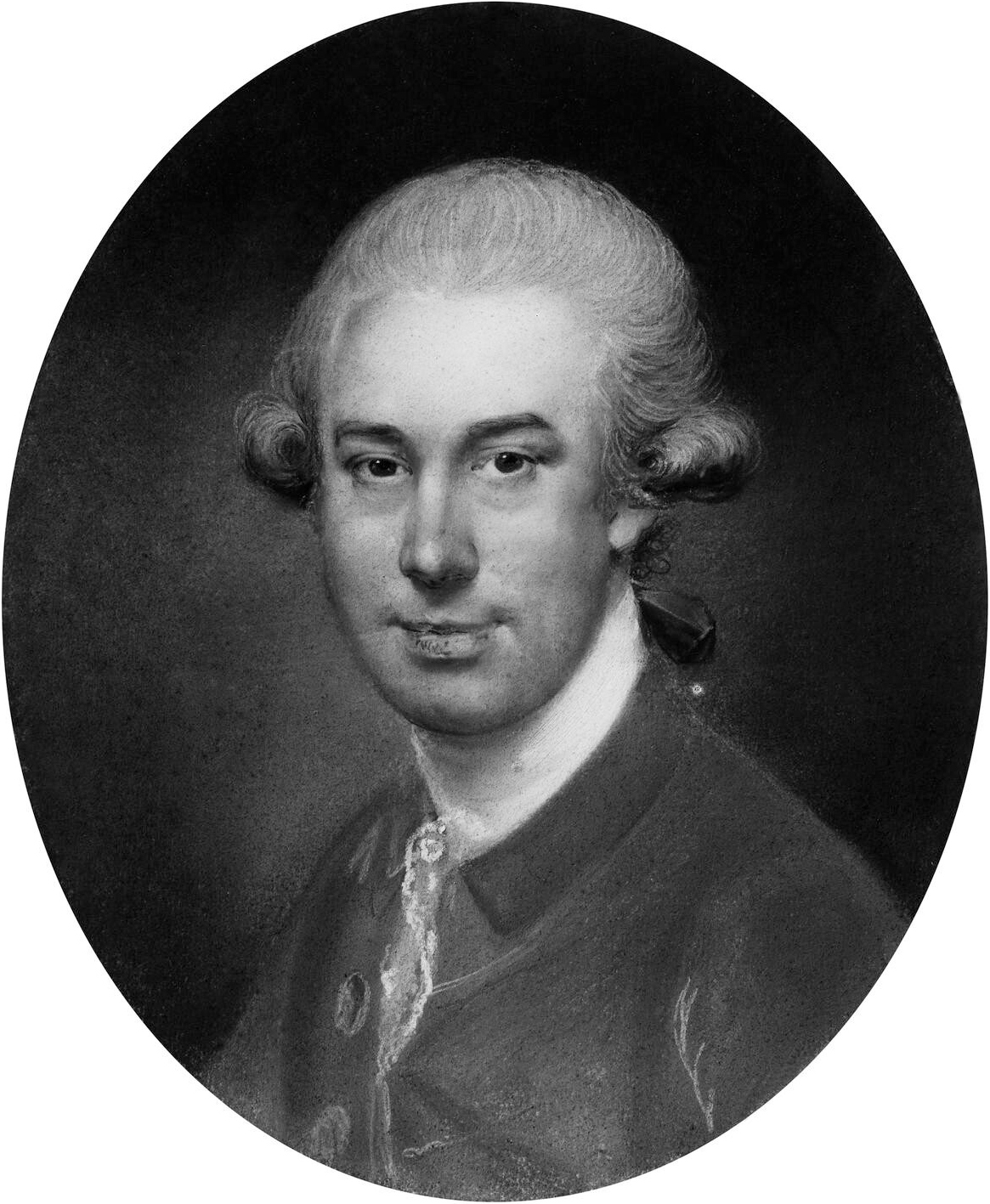
The Selenographia, to give the device its proper name, was invented by portrait artist John Russell, who had spent more than 30 years pursuing part-time cartography as a hobby, studying the surface of the Moon, using the finest telescopes available.
It consists of a large lunar sphere – like today’s globes mapping the Earth – and a small terrestrial sphere to reproduce the motions of the Moon in respect to our planet. Only one side is illustrated, and the other is blank, because only one side of the Moon is visible from Earth.

These days, it’s on display in the Pagoda Room of historic Burghley House in Stamford, Lincolnshire, where it has been in the family ever since it was collected, thanks to a happy coincidence, by Henry, 10th Earl and 1st Marquess of Exeter, in 1800.
History shows how society portraitist Russell was hired to paint the Earl’s children. When the painting was completed, the artist showed off his latest invention and persuaded the Earl to part with 26 guineas for it. That’d be around £1,900 today.

And when you consider the average annual wage back then is reckoned to have been £46.50, it was a big buy.
Whether or not the Earl got to fully appreciate his purchase remains in question. The Selenographia was rediscovered in a store room in 1985, still in the pine box in which it was shipped from London, packed in protective sheepswool and with a label attached giving directions to change horses at Bedford!

But what about the boffins, you ask? Some years ago, the device was loaned to an exhibition at the Houston Museum of Art, where one of the many visitors was a senior lunar scientist from NASA, who was so excited that he wrote to Burghley’s Curator.
In the letter, the expert expressed utter amazement at the degree of accuracy displayed by the device.
You can read more about Burghley, and its attractions, including the moon globe, at burghley.co.uk.
Read more: Batman’s home moved in a Flash to historic Burghley


 Paul Cole Writes
Leave a comment